4072d203-a716-4abf-b5c0-b7f429dea497.tmb-blogpost.png?Culture=en&sfvrsn=7ca219d6_3)

⏱ 4 min read, 5 min video
Nearly one-third of older Canadians take sleeping pills, also called sedative-hypnotics or tranquilizers, to manage insomnia or anxiety. But these medications — frequently benzodiazepines or “Z” drugs — often provide limited benefit and carry serious risks. Watch this short video to learn why sleeping pills may not be the best solution for older adults and discover safer, more effective ways to improve sleep.
View or download a transcript.
Highlights include:
- 00:30 What is insomnia?
- 00:51 Do sleeping pills really help?
- 02:17 The real risk: benefits vs harms
- 02:39 Risks for older adults
- 03:20 A safer path to better sleep: Cognitive Behavioural Therapy for Insomnia
What is insomnia?
Insomnia disorder isn't just one bad night. It’s defined as having trouble falling or staying asleep at least three nights a week, for three months or more, and it significantly affects your daytime functioning, leaving your 'battery' feeling low.
Why sleeping pills aren't always the answer
Sleeping pills, including benzodiazepines and “Z” drugs, are commonly prescribed for insomnia and anxiety. But studies show that, on average, people who take one of these drugs sleep only 23 minutes longer than those who don’t take a drug.
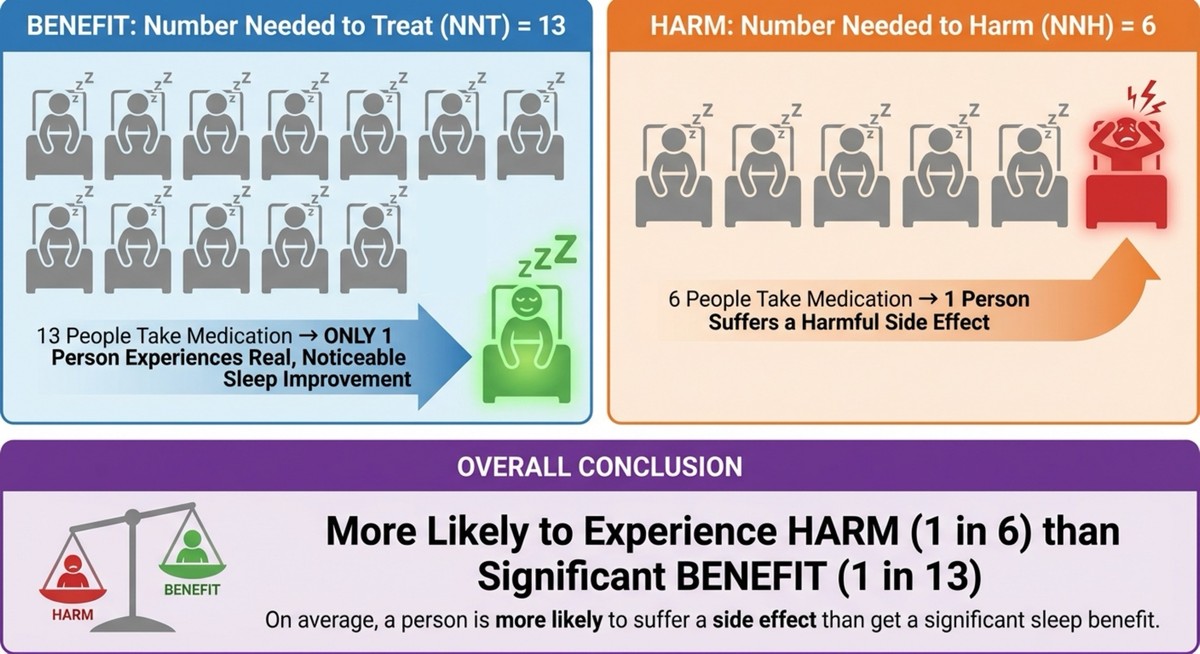
In medical terms, we often look at the 'Number Needed to Treat' or NNT. For these medications, the Number Needed to Treat is 13. This means 13 people need to take the medication for only one person to experience a real, noticeable improvement in their sleep quality. On the other hand, the 'Number Needed to Harm' or NNH is 6, meaning for every 6 people who take sleeping pills, one person will suffer a harmful side effect. So, on average, a person is actually more likely to experience harm from a sleeping pill than to get a significant sleep benefit (Figure 1).
Figure 1: Sleeping Pills - Number Needed to Treat versus Number Needed to Harm
Benefits and Harms of Sleep Medication
This infographic compares the likelihood of meaningful benefit versus harm from sleep medication using the concepts of Number Needed to Treat (NNT) and Number Needed to Harm (NNH).
Benefit: Number Needed to Treat (NNT) = 13
Thirteen people need to take the medication for one person to experience a real, noticeable improvement in sleep. The other twelve people do not experience this significant benefit.
Harm: Number Needed to Harm (NNH) = 6
Six people need to take the medication for one person to experience a harmful side effect. The other five people do not experience that harm.
Overall Conclusion
Based on these averages, a person taking sleep medication is more likely to experience a harmful side effect (1 in 6 people) than a significant sleep benefit (1 in 13 people).
The infographic emphasizes that, on average, the risk of harm outweighs the likelihood of a meaningful improvement in sleep.
Risks you should know about
For older adults, these medications can cause confusion, memory problems, and balance issues. This can more than double your risk of falls and hip fractures—serious injuries that often lead to hospitalization. There’s also an increased risk of car accidents. And the newer “Z” drugs, like zolpidem (Ambien®) and zopiclone (Imovane®), aren’t necessarily safer. They carry similar risks and may lead to dependence, withdrawal, or substance use disorders.
Common medications for sleep and anxiety
Several types of medications are sometimes used to treat sleep problems or anxiety. All of the medications listed below can carry risks for older adults. This table shows the drug name and an example of a brand name you might recognize. It is not a complete list and is shared for information only.
Table 1: Medications used to treat insomnia
| Medication type | Drug name | Example brand name(s) |
| Benzodiazepines (used for anxiety) | Alprazolam | Xanax® |
| Clonazepam | Rivotril® | |
| Diazepam | Valium® | |
| Lorazepam | Ativan® | |
| Benzodiazepines (used for insomnia) | Flurazepam | Generic only |
| Oxazepam | Serax® | |
| Temazepam | Restoril® | |
| Triazolam | Halcion® | |
| "Z" drugs (sleep medications) | Zolpidem | Ambien® |
| Zopiclone | Imovane® | |
| Antipsychotic or antidepressant medications (sometimes used for sleep) | Mirtazapine | Remeron® |
| Quetiapine | Seroquel® | |
| Trazodone | Desyrel® | |
| Amitriptyline | Elavil® | |
| Doxepin | Silenor®, Sinequan® | |
| Over-the-counter sleep products | Diphenhydramine | Benadryl Allergy®, Nytol®, Sominex®, Gravol® |
| Combination products | Advil PM®, Tylenol PM® |
Safer ways to improve sleep
The good news? There are better options. Start with a medical check-up to rule out underlying causes like depression, pain, or restless leg syndrome. Then, try these strategies from Choosing Wisely Canada:
- Exercise. Physical activity helps people sleep better, but avoid vigorous exercise several hours before bedtime.
- Keep a regular sleep schedule. Try to go to bed and wake up at about the same time every day, even on weekends.
- Try not to eat right before bedtime. Eat 3 hours or more before going to bed.
- Avoid caffeine after 3 pm. Some people may need to avoid caffeine even earlier.
- Limit alcohol. Alcohol causes sleepiness at first, followed by wakefulness.
- Create the right environment. Keep the bedroom peaceful and avoid mental excitement before bedtime.
- Avoid bright lights. Watching a bright screen can cause you to stay awake.
- Control pets. Pets disrupt sleep if they are on and off the bed, taking up space, or wanting to be let out.
If you don’t fall asleep soon after going to bed, get up and do something that will make you sleepy, such as reading, and return to bed when you start to feel drowsy.
These changes can make a big difference without the risks that come with medication.
Download a helpful handout from Choosing Wisely Canada with these tips.
CBT-I: A skill, not a pill
Cognitive Behavioural Therapy for Insomnia, or CBT-I is the first-line evidence-based treatment recommended by experts. Most importantly: it’s a skill, not a pill.
CBT-I works by changing habits. Stimulus control retrains your brain to associate the bed only with sleep — not scrolling on your phone or watching TV. Sleep restriction temporarily limits your time in bed to make your sleep more efficient, helping you fall asleep faster and stay asleep longer.
CBT-I also addresses the psychological side of insomnia. Cognitive therapy helps replace unhelpful, anxious beliefs about sleep with more realistic ones. Here are some examples:
Table 2: Anxious versus realistic beliefs about sleep
| Anxious belief | Realistic belief |
| "If I don’t get 8 hours of sleep, I won’t be able to function tomorrow." | "I might feel tired tomorrow, but I’ve gotten through days like this before, and often better than I expect." |
| "If I wake up during the night, it means something is wrong with my sleep." | "Waking up during the night is normal, especially as we age. What matters is how I respond when it happens." |
Coupled with relaxation techniques to calm the mind and body, these tools provide long-lasting benefits without the side effects of medication.
Interested in learning more or getting started with CBT-I? There are many free resources, including websites such as MySleepWell.ca and free apps like CBT-i Coach.
When to talk to your healthcare provider
If you are having trouble sleeping and considering sleeping pills speak to your healthcare provider and ask:
- What are the risks for someone my age?
- Are there non-drug options I can try first?
- If medication is necessary, how can we minimize the risks?
If you are taking medications, don't stop abruptly. Talk to your healthcare team about your options.
Tell us what you think
Give us your feedback on this content by answering a few questions. Your participation will help us improve this resource. Take the survey.
_jpg.jpg?sfvrsn=bcb0dd6_2)