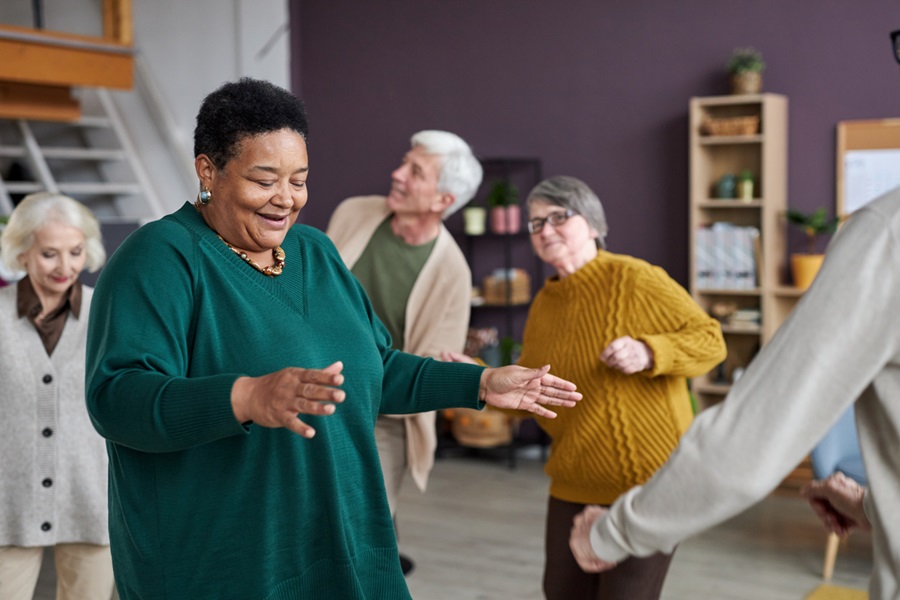

Dance helps us express our emotions, tell our stories, showcase our cultures, and celebrate moments of happiness. Be it at a recital, wedding, concert, class, or our home, dance is an art form that we can enjoy in a diversity of settings. But beyond being beautiful, fun, and accessible, dance and dancing have also become areas of interest for researchers. If you’re wondering why, the answer is our health. That’s right, researchers are looking into how dance and dancing can help improve various areas of our health—like falls, cognition, and physical function, to name a few (1-4). Click on the links below to learn more.
The risk of falls, especially fatal falls, increases as we age (5). Exercise is an important element of fall prevention. Dance-based mind-motor activities, such as Tai Chi, are types of exercise. Research shows that Tai Chi may decrease the number of healthy older adults who fall, as well as the number of falls they experience. Evidence further suggests that engaging in dance-based mind-motor activities 3 or more times a week over 12 to 24 weeks may provide the greatest benefits. That said, more research is needed on the optimal frequency and length of exercise and different dance-based mind-motor activities (1).
In older adults, declining cognitive function is a leading cause of disability and death (2;6). Research shows that combining brain training and physical activity can improve cognitive function in older adults living with or without mild cognitive impairment (2). What’s more, it seems that engaging in these activities simultaneously—versus one after the other—may be most beneficial (2;3). Dance is one example of an activity that allows people to engage in exercise and brain training at the same time. More research is needed on the most effective frequencies, durations, and lengths of programs that combine these activities (2).
Across Canada, more than 18 million people play video games (7). Exergames are active video games that require players to engage in physical activity. As the individual plays, performance is tracked, and feedback is relayed using motion sensors and other technologies (2;8;9). Dance exergames, which involve dancing to music, are one category of exergames. Research shows that dance exergames can improve multiple components of physical function in older adults—including dynamic balance, reaction time, and movement time. More research is needed to further confirm these findings (2).
Whether we have two left feet or can stay on beat, dance is for us to enjoy! From salsa to square dancing and our homes to dance classes, there are so many different styles of dance to explore and settings to practice them in. Remember to speak with your healthcare team about how you can safely engage in this activity (e.g., is there a need for supervision, adapting movements, an optimal setting, etc.) before starting.