
3 evidence-based benefits of tai chi

The Bottom Line

  • Tai chi is a mind-body exercise practiced by more than 300 million people worldwide.
  • Research shows that tai chi may improve cognitive function, support diabetes management, and reduce symptoms of anxiety and depression.
  • Speak with your healthcare team about if and how to incorporate tai chi into your exercise routine. 

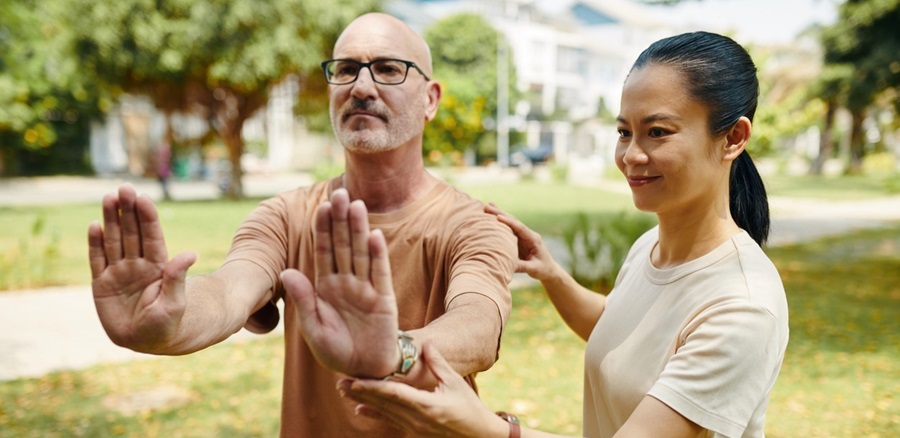
Tai chi is a mind-body practice characterized by slow, controlled movements and deep, natural breathing (1). Originating in China, it’s now practiced by more than 300 million people across the globe (1;2). Given tai chi’s popularity, it should come as no surprise that researchers have taken interest in its potential impacts on everything from our cognitive health to diabetes management (3-6). Click on the links below to learn more.


1. Improves cognitive function

Many of us seek activities that help us stay sharp as we age. Research shows that tai chi may help enhance working memory in adults over 50 with or without mild cognitive impairment (3). Working memory refers to the ability to temporarily hold onto and use information to complete a task, such as cooking a new recipe.  


2. Supports diabetes management

Uncontrolled type 2 diabetes can increase the risk of experiencing many health issues, including heart attacks, strokes, vision loss, and nerve damage that leads to amputations (7). To lower these risks, diabetes management is key. Research shows that tai chi may reduce fasting blood sugar and body mass index in people living with type 2 diabetes. Additionally, certain aspects of quality of life may also improve (4;5).   


3. Enhances mental health

Internationally, depression and anxiety continue to be two of the most common mental health disorders (8;9). Research shows that traditional Chinese exercises like tai chi may decrease symptoms of depression and anxiety in older adults. Optimal effects on symptoms are dependent on the characteristics of the tai chi program (6).    


Tai chi appears to be a safe, low-impact exercise that older adults can add to their optimal aging toolkits. Practiced at home with the help of a YouTube video or at the park with peers and the guidance of a teacher, tai chi offers flexibility and community. Speak with your healthcare team about whether tai chi is a good fit for you. 

Featured Resources


Get the latest content first. Sign up for free weekly email alerts.
Subscribe
Author Details

References

  1. Harvard Health Publications. The health benefits of tai chi. [Internet] 2022. [cited November 2025] Available from: http://www.health.harvard.edu/newsletters/Harvard_Womens_Health_Watch/2009/May/The-health-benefits-of-tai-chi
  2. Liu D, Zhou B, Wen Z, et al. From healing and martial roots to global health practice: Reimagining Tai Chi (Taijiquan) in the modern public fitness movement. Front Public Health. 2025; 13:1677470. doi: 10.3389/fpubh.2025.1677470.
  3. Northey JM, Cherbuin N, Pumpa KL, et al. Exercise interventions for cognitive function in adults older than 50: A systematic review with meta-analysis. Br J Sports Med. 2018; 52(3):154-160. doi: 10.1136/bjsports-2016-096587. 
  4. Yu X, Chau JPC, Huo L. The effectiveness of traditional Chinese medicine-based lifestyle interventions on biomedical, psychosocial, and behavioural outcomes in individuals with type 2 diabetes: A systematic review with meta-analysis. Int J Nurs Stud. 2018; 80:165-180. doi: 10.1016/j.ijnurstu.2018.01.009.  
  5. Zhou Z, Zhou R, Zhu Y, et al. Effects of tai chi on physiology, balance and quality of life in patients with type 2 diabetes: A systematic review and meta-analysis. J Rehabil Med. 2019; 51(6):405-417. doi: 10.2340/16501977-2555. 
  6. Dong Y, Pang D, Xiang J, et al. Exploring the benefits of traditional Chinese exercises (Tai Chi and Qigong) on the anxiety and depression of older adults: A systematic review and meta-analysis. Medicine. 2025; 104(12).
  7. World Health Organization. Diabetes. [Internet] 2024. [cited November 2025]. Available from: https://www.who.int/news-room/fact-sheets/detail/diabetes
  8. World Health Organization. Depressive disorder (depression). [Internet] 2025. [cited November 2025]. Available from:  https://www.who.int/news-room/fact-sheets/detail/depression
  9. World Health Organization. Anxiety disorders. [Internet] 2025. [cited November 2025]. Available from: https://www.who.int/news-room/fact-sheets/detail/anxiety-disorders

DISCLAIMER: These summaries are provided for informational purposes only. They are not a substitute for advice from your own health care professional. The summaries may be reproduced for not-for-profit educational purposes only. Any other uses must be approved by the McMaster Optimal Aging Portal (info@mcmasteroptimalaging.org).

Many of our Blog Posts were written before the COVID-19 pandemic and thus do not necessarily reflect the latest public health recommendations. While the content of new and old blogs identify activities that support optimal aging, it is important to defer to the most current public health recommendations. Some of the activities suggested within these blogs may need to be modified or avoided altogether to comply with changing public health recommendations. To view the latest updates from the Public Health Agency of Canada, please visit their website.